Environmental Engineering
Environmental Engineering focuses on applying science and engineering principles to assess, manage, and design sustainable systems that address environmental challenges, aiming to protect and improve both human and ecological health. The designs and technologies created ensure safe and reliable public water systems, facilitate effective wastewater and waste treatment, and support resource recovery. These advancements also control pollutant emissions, safeguarding the quality of water, soil, and air. With a solid foundation in fundamental sciences, mathematics, computational approaches, and engineering, environmental engineers are equipped to implement technological solutions across various environmental and social contexts. Graduates of Addis Ababa Science and Technology University (AASTU) environmental engineering program are prepared to enter the workforce or pursue further studies in related fields.
The graduate work in diverse sectors, including industries, public healthy, agriculture, construction design and supervision, urban infrastructure, water and wastewater treatment facilities, air pollution management, waste management, environmental remediation, environmental protection authorities, NGOs (local and international), startups and social enterprise, renewable energy, and other sectors. Their responsibilities include overseeing the operation and maintenance of environmental systems, troubleshooting pollution control issues, and implementing modifications to improve sustainability, efficiency, safety, and health in environmental processes.
The Bachelor of Environmental Engineering program provides a strong foundation in subjects like Mathematics, Physics, Biology, Geology, Chemistry, Social and Humanity courses. The curriculum then covers core engineering disciplines such as Fluid Mechanics, Thermodynamics, Reaction Engineering, Surveying, and Software applications for environmental Engineering.
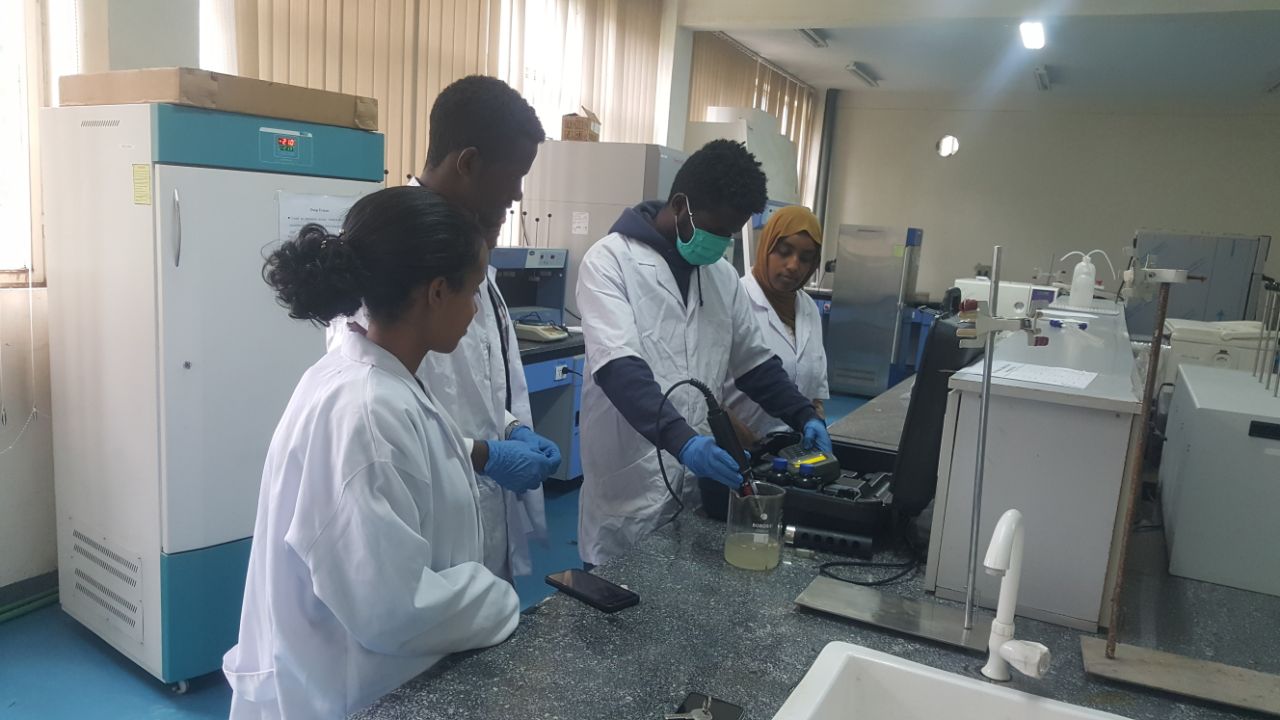
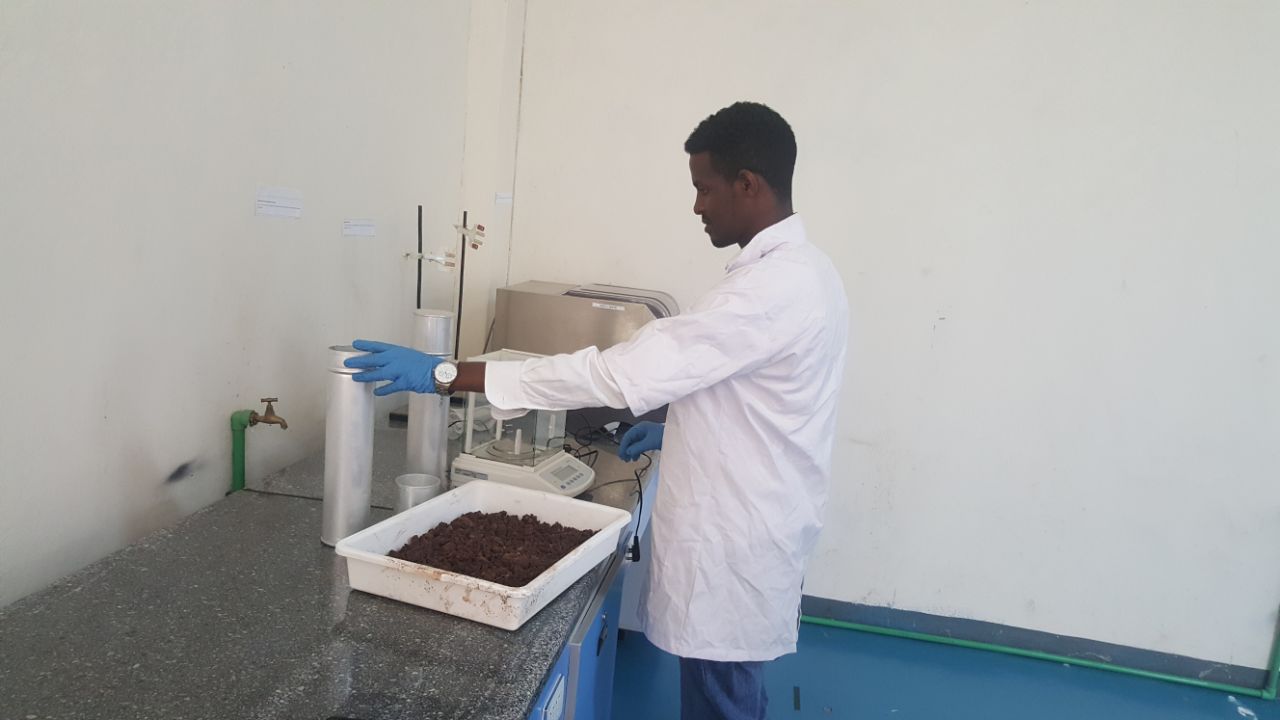
As students’ progress, the program introduces key topics such as Water and Wastewater Treatment, Air pollution control Engineering, Soil pollution and remediation technology, Environmental Impact Assessment, Environmental Policy and Management Systems, Healthy, Safety, and Environmental Engineering, Sustainable Resource Management, and Laboratory practical incorporated in major courses. Apart from courses mentioned above students are also engaged in professional development course (Internship), team project at college level (integrated team project) and department level (Integrated Environment Engineering team project design and final year project).
| Code | Course | Cr | Indicate whether the course is required (R)or Elective (E) |
|---|---|---|---|
| Phys1001 | General Physics | 3 | R |
| FLEn1003 | Communicative English Language Skill – I | 3 | R |
| GeEs1005 | Geography of Ethiopia and the Horn | 3 | R |
| Math1007 | Mathematics for Natural Science | 3 | R |
| Phil1009 | Logic and Critical Thinking | 3 | R |
| Psyc1011 | General Psychology | 3 | R |
| SpSc1013 | Physical Fitness | P/F | R |
| Total | 18 | ||
| Code | Course | Cr | Indicate whether the course is required (R)or Elective (E) |
|---|---|---|---|
| Anth1002 | Social Anthropology | 2 | R |
| FLEn1004 | Communicative English Language Skill-II | 3 | R |
| EmTe1108 | Emerging Technologies for Engineers | 3 | R |
| Entr1106 | Entrepreneurship for Engineers | 3 | R |
| Incl1010 | Inclusiveness | 2 | R |
| MCiE1012 | Moral and Civic Education | 2 | R |
| Math1014 | Applied Mathematics IB | 4 | R |
| Total | 19 | ||
| Code | Course | Cr.hrs. | Indicate whether the course is required (R)or Elective (E) |
|---|---|---|---|
| MEng2101 | Engineering Drawing | 3 | R |
| Comp2003 | Introduction to Computer Programming | 3 | R |
| CEng2103 | Engineering Mechanics I (Statics) | 3 | R |
| Math2007 | Applied Mathematics IIB | 4 | R |
| Econ2009 | Economics | 3 | R |
| GLTr2011 | Global Trend | 2 | R |
| Total | 18 | ||
| Code | Course | Cr. hrs. | Indicate whether the course is required (R)or Elective (E) |
|---|---|---|---|
| Math2042 | Applied Mathematics IIIB | 4 | R |
| EnEg2102 | Environmental Microbiology | 3 | R |
| MEng2102 | Engineering Mechanics II (Dynamics) | 3 | R |
| ChEg2104 | Thermodynamics | 4 | R |
| Hist2002 | History of Ethiopia and the Horn | 3 | R |
| CEng2102 | Strength of Materials | 2 | R |
| Total | 19 | ||
| Code | Course | Cr.hrs. | Indicate whether the course is required (R)or Elective (E) |
|---|---|---|---|
| EnEg3103 | Environmental Chemistry | 3 | R |
| ChEg3101 | Material and Energy Balance | 2 | R |
| EnEg3105 | Environmental Engineering Hydrology | 3 | R |
| ChEg3103 | Fluid Mechanics | 3 | R |
| EnEg3107 | Transport Phenomena for Environmental Engineering | 3 | R |
| CEng3101 | Strength of Materials | 2 | R |
| EnEg3101 | Fundamental of Soils and Pollution Control | 3 | R |
| Total | 19 | ||
| Code | Course | Cr. hrs | Indicate whether the course is required (R)or Elective (E) |
|---|---|---|---|
| Stat3102 | Probability and Statistics | 3 | R |
| EnEg3104 | Air pollution Engineering I | 3 | R |
| CEng3102 | Reinforced Concrete Design | 3 | R |
| EnEg3106 | Water Treatment Engineering | 3 | R |
| ChEg3102 | Unit Operation | 3 | R |
| ChEg3104 | Reaction Engineering | 3 | R |
| Total | 18 | ||
| Code | Course | Cr. hrs | Indicate whether the course is required (R)or Elective (E) |
|---|---|---|---|
| EnEg4101 | Air Pollution Engineering II | 3 | R |
| IETP4115 | Integrated Engineering Team Project | 3 | R |
| EnEg4105 | Engineering Economics | 3 | R |
| EnEg4103 | Numerical Analysis for Environmental Engineering | 3 | R |
| EnEg4107 | Energy and Environment | 3 | R |
| EnEg4109 | Wastewater Treatment Engineering | 3 | R |
| Total | 18 | ||
| Code | Course | Cr. hrs | Indicate whether the course is required (R)or Elective (E) |
|---|---|---|---|
| EnEg4102 | Solid Waste Engineering | 3 | R |
| EnEg4104 | Sewerage and Drainage Engineering | 3 | R |
| EnEg4106 | GIS and Remote Sensing | 3 | R |
| EnEg4108 | Software Applications for Environmental Engineering | 3 | R |
| EnEg4110 | Waste to Energy Technology | 3 | R |
| EnEg4112 | Environmental Impact Assessment | 2 | R |
| EnEg4114 | Environmental Policy and Management Systems | 2 | R |
| Total | 19 | ||
| Code | Course | Cr. hrs | Indicate whether the course is required (R)or Elective (E) |
|---|---|---|---|
| EnEg4116 | Internship | 18 | R |
| Total | 18 | ||
| Code | Course | Cr. hrs. | Indicate whether the course is required (R)or Elective (E) |
|---|---|---|---|
| EnEg5111 | Integrated Environmental Engineering Project Design | 3 | R |
| EnEg5101 | Renewable Energy Engineering | 3 | R |
| EnEg5103 | Ecological Engineering | 3 | R |
| EnEg5105 | Hazardous and E-waste Engineering | 3 | R |
| EnEg5109 | Soil Pollution Remediation Technologies | 3 | R |
| EnEg51xx | Elective | 3 | R |
| EnEg5107 | Final Year Project I | 3 | R |
| Total | 17 | ||
| Code | Course | Cr. hrs | Indicate whether the course is required (R)or Elective (E) |
|---|---|---|---|
| EnEg5102 | Industrial Waste Management Technologies | 3 | R |
| EnEg5104 | Health, Safety and Environment (HSE) Engineering | 3 | R |
| EnEg5106 | Final Year Project II | 6 | R |
| EnEg5108 | Climate Change, Adaptation & Mitigation Technologies | 3 | R |
| EnEg5109 | Environmental Geology | 3 | R |
| Total | 18 | ||
| Code | Course | Cr. hrs | Indicate whether the course is required (R)or Elective (E) |
|---|---|---|---|
| EnEg5202 | Environmental Biotechnology | 3 | E |
| EnEg5204 | Air Quality Modeling and Forecasting | 3 | E |
| EnEg5206 | Cleaner production and LCA | 3 | E |
| EnEg5208 | Sludge Treatment Technologies | 3 | E |
| EnEg52010 | Ecological Risk Assessment | 3 | E |
| EnEg5212 | Green Building and Energy Conservation | 3 | E |
Program Educational Objectives
Environmental Engineering Program
Some graduates will become professional environmental engineers.
Some graduates will exercise a managerial position in industries, government, and non-government organizations to achieve their goals.
Some graduates will become innovators in environmental engineering field.
Some graduates will become lifelong learners in the field of environmental engineering.
Program Outcomes (POs)
- PO-1: Apply knowledge of mathematics, natural science, computing and engineering fundamentals, and an environmental engineering specialization to solve complex environmental engineering problems.
- PO-2: An ability to identify, formulate, and solve complex engineering problems by applying principles of engineering, science, and mathematics.
- PO-3: An ability to apply engineering design to produce solutions that meet specified needs with consideration of public health, safety, and welfare, as well as global, cultural, social, environmental, and economic factors.
- PO-4: An ability to develop and conduct appropriate experimentation, analyze and interpret data, and use engineering judgment to draw conclusions.
- PO-5: Create, select and apply, and recognize limitations of appropriate techniques, resources, and modern engineering and IT tools, including prediction and modeling, to complex engineering problems.
- PO-6: Apply reasoning informed by contextual knowledge to assess societal, health, safety, legal and cultural issues and the consequent responsibilities relevant to professional environmental engineering practice and solution to complex environmental engineering problems.
- PO-7: Understand the impact of professional engineering solutions in societal and environmental contexts and demonstrate knowledge of and need for sustainable development.
- PO-8:An ability to recognize ethical and professional responsibilities in engineering situations and make informed judgments, which must consider the impact of engineering solutions in global, economic, environmental, and societal contexts.
- PO-9: An ability to function effectively on a team whose members together provide leadership, create a collaborative and inclusive environment, establish goals, plan tasks, and meet objectives.
- PO-10: An ability to communicate effectively with a range of audiences.
- PO-11: Demonstrate knowledge and understanding of engineering management principles and economic decision-making to function effectively on a team whose members together provide leadership, create a collaborative environment, establish goals, plan tasks, and meet objectives.
- PO-12: An ability to acquire and apply new knowledge as needed, using appropriate learning strategies.
Graduate Requirements
In AASTU, to complete the five-year bachelor program, the student must take a minimum of 180 Cr. Hr., while the maximum is 190 Cr. Hr. as per AASTU Senate Legislation Article 109. Accordingly, students in the Environmental Engineering program should take 188 Cr. Hr.
Furthermore, students enrolled in the program must receive a CGPA of 2.00, pass all courses with a pass/fail grading scheme, and must not receive an "F" grade in any of their courses.
Table 1. Distribution of Total Credit Hours as per Course Categories
| Summary distribution of credit hours for all course categories | Credit Hours | Percentage |
|---|---|---|
| NR - National Requirement | 35 | 18.62% |
| UR - University Requirement | 3 | 1.60% |
| CC - Core Course (major and supportive course) | 126 | 67.00% |
| CL - Core Industrial Internship | 18 | 9.60% |
| CSP - Core Specialization | 6 | 3.19% |
| Total | 188 | 100% |
| Sr. No. | Name | Sex | Academic Rank | Contact Address (Phone/AASTU email) | Specialization | Remark |
|---|---|---|---|---|---|---|
| 1 | Abebe Worku Gebeyehu (Ph.D) | M | Associate Professor | +251911754311 abebe.worku@aastu.edu.et | Water and Wastewater Treatment Engineering | |
| 2 | Kenatu Angassa Wakuma (Ph.D) | F | Associate Professor | +251911944009 kenatu.angassa@aastu.edu.et | Water and Wastewater Treatment Engineering | |
| 3 | Zemene Worku Negie (Ph.D) | M | Associate Professor | +251911900071 zemene.worku@aastu.edu.et | Environmental Science Specialization: Environmental Pollution and Sanitation | |
| 4 | Tsedekech G/Meskel (Ph.D) | F | Assistant Professor | +251911382876 tsedekech.gebremeskel@aastu.edu.et | Environmental Science | |
| 5 | Bereket Tesfaye Haile (Ph.D) | M | Assistant Professor | +251913037440 bereket.tesfaye@aastu.edu.et | Environmental Science (Climate Modeling) | |
| 6 | Israel Tessema Lewte (Ph.D) | M | Assistant Professor | +251911315896 israel.tessema@aastu.edu.et | Environment & Development | |
| 7 | Eskinder Zinabu Belachew (Ph.D) | M | Assistant Professor | +251941277664 eskinder.zinabu@aastu.edu.et | Land Management & Pollution Control | |
| 8 | Achenafi Teklay G/Silassie (Ph.D) | M | Assistant Professor | +251969714102 achenafi.teklay@aastu.edu.et | Water Resource Engineering and Management | |
| 9 | Feleke Kuraz Sishu (Ph.D) | M | Assistant Professor | +251982507661 feleke.kuraz@aastu.edu.et | Water Resource Engineering and Management | |
| 10 | Mintesnote Gizaw Terefe (Ph.D) | M | Assistant Professor | +251942540471 mintesnot.gizaw@aastu.edu.et | Energy and Climate ORCiD | |
| 11 | Alemshet Ayele Admasu (Ph.D) | F | Lecturer | +251912015164 alemshet.ayele@aastu.edu.et | Sustainable Energy | |
| 12 | Arkbom Hailu Asfaw (Ph.D) | M | Lecturer | +251912182234 arkbom.hailu@aastu.edu.et | Energy Technologies | |
| 13 | Mr. Bimrew Bizualem Fetene | M | Lecturer | +251924786815 bimrew.bizualem@aastu.edu.et | Environmental Engineering | |
| 14 | Mr. Takele Sime Tessema | M | Lecturer | +251945625253 takele.sime@aastu.edu.et | Environmental Engineering | |
| 15 | Solomon Tilahun Kebede | M | Lecturer | +251912844166 solomon.tilahun@aastu.edu.et | Environmental Science | |
| 16 | Seble Kebede Kibret | F | Lecturer | +251910440818 seble.kebede@aastu.edu.et | Water Supply and Sanitary Engineering | |
| 17 | Solomon Tibebu Gebreabe | M | Lecturer | +251902321833 solomon.tibebu@aastu.edu.et | Environmental Engineering | |
| 18 | Asamin Yesigat | M | Lecturer | +251911568993 asamin.yesigat@aastu.edu.et | Environmental Science | |
| 19 | Getahun Kebede Mengistie | M | Lecturer | +251912760452 getahun.kebede@aastu.edu.et | Environmental Engineering | |
| 20 | Mihret Elias Wolloro | F | Lecturer | +251910623743 miheret.elias@aastu.edu.et | Energy Technologies | |
| 21 | Beyene Tsegaye Stota | M | Senior Academic Research Assistant | +251921604702 beyene.tsegaye@aastu.edu.et | Computer Science | |
| 22 | Belay Akno Nme | M | Chief 2 Research Assistant | +251910420389 belay.akno@aastu.edu.et | Organic Chemistry | |
| 23 | Rina Mubeshir Mohammed | F | Chief Research Assistant | +251947380547 rina.mubeshir@aastu.edu.et | Environmental Engineering | |
| 24 | Abebaw Shibeshi Deresso | M | Chief Research Assistant | +251938046509 abebaw.shibeshi@aastu.edu.et | Environmental Engineering | |
| 25 | Andualem Arka Ammona | M | Chief Research Assistant | +251941419835 andualem.arka@aastu.edu.et | Environmental Engineering |